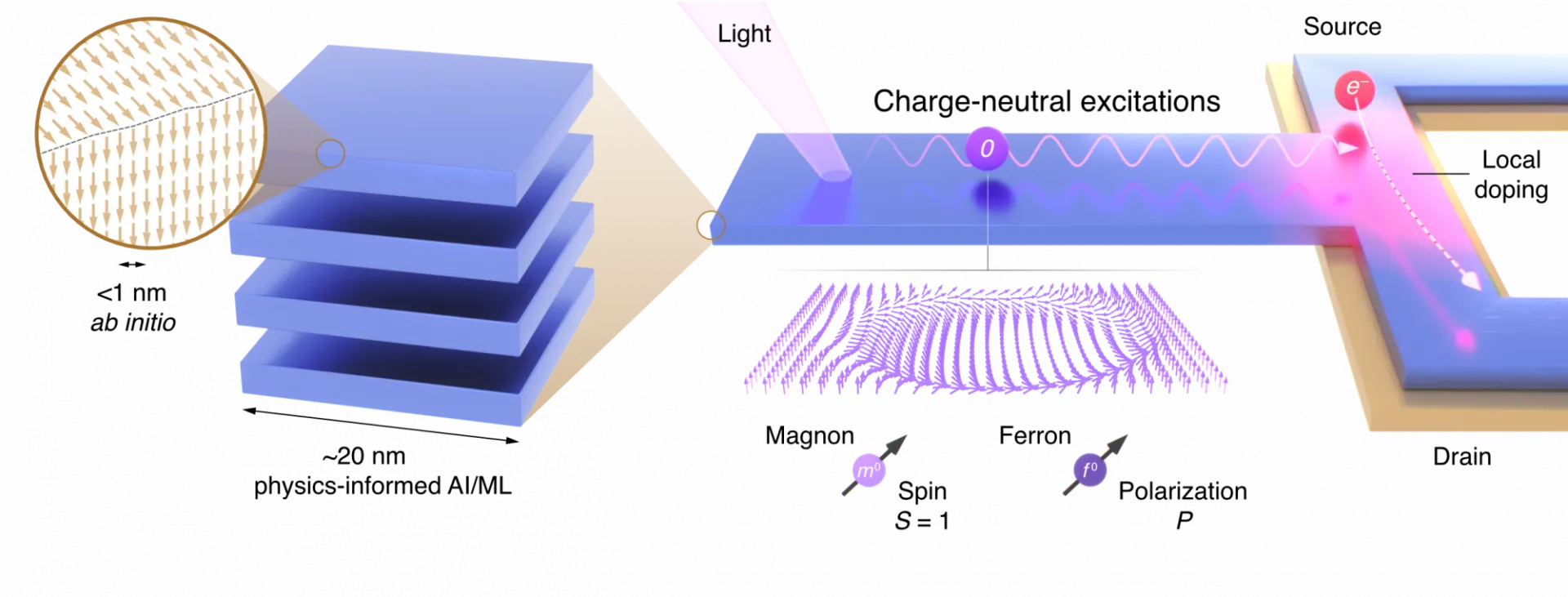
IRG 1: Advanced Semiconductors for Coherent Charge-Neutral Information Flow
ABOUT IRG1
IRG1 establishes a new materials paradigm for next-generation information systems based on coherent charge-neutral excitations capable of nearly dissipation-free information transport over microns. IRG1 seeks to:
- Develop new vdW semiconductors with ferromagnetic, ferroelectric, multiferroic, and altermagnetic orders that host coherently propagating charge-neutral excitations addressable optically and electronically, enabling systematic optimization of lifetimes and propagation lengths; and
- Integrate materials and excitations with optical and electrical signals to demonstrate their viability as interconnects and information-processing platforms.
IRG1 seeks to study designed materials with a suite of cutting-edge spectroscopy, microscopy, and devices to refine models for transduction and transport, and will create a library of vdW semiconductors with enhanced intrinsic transduction (InT) for nearly dissipation-free interconnects, demonstrations of optical and electrical transduction in devices, and extensions to quantum phenomena.
PARTICIPANTS
Faculty Leaders: Aravind Devarakonda, David R. Reichman
Primary Participants: Tim Berkelbach, Cory Dean, Milan Delor, Lia Krusin-Elbaum (CCNY), Xavier Roy, Michele Simoncelli, Xiaoyang Zhu
Primary National Lab & International Participants: Eric Bauer (LANL), Allen Scheie (LANL), Ashish Kundu (BNL), Elio Vescovo (BNL)
Postdocs: TBC
Graduate Students: Ye Hwi Oh (Devarakonda), Kylie Thompson (Devarakonda), Adam Williams (Dean)
FOUNDATIONAL RESULTS
IRG1 is built on foundational results achieved recently by this team of co-PIs, including the synthesis of novel ferroic platforms and the demonstration of long-lived charge-neutral excitations in them. Research underpinning the intellectual basis of IRG1 include findings on magnetic semiconductor CrSBr, optically addressable coherent magnons in semiconducting CrSBr, ferroelectric vdW materials, and the discovery of coherent ferrons in semiconducting NbOI2.
The following publications are key to the research being conducted by IRG1: